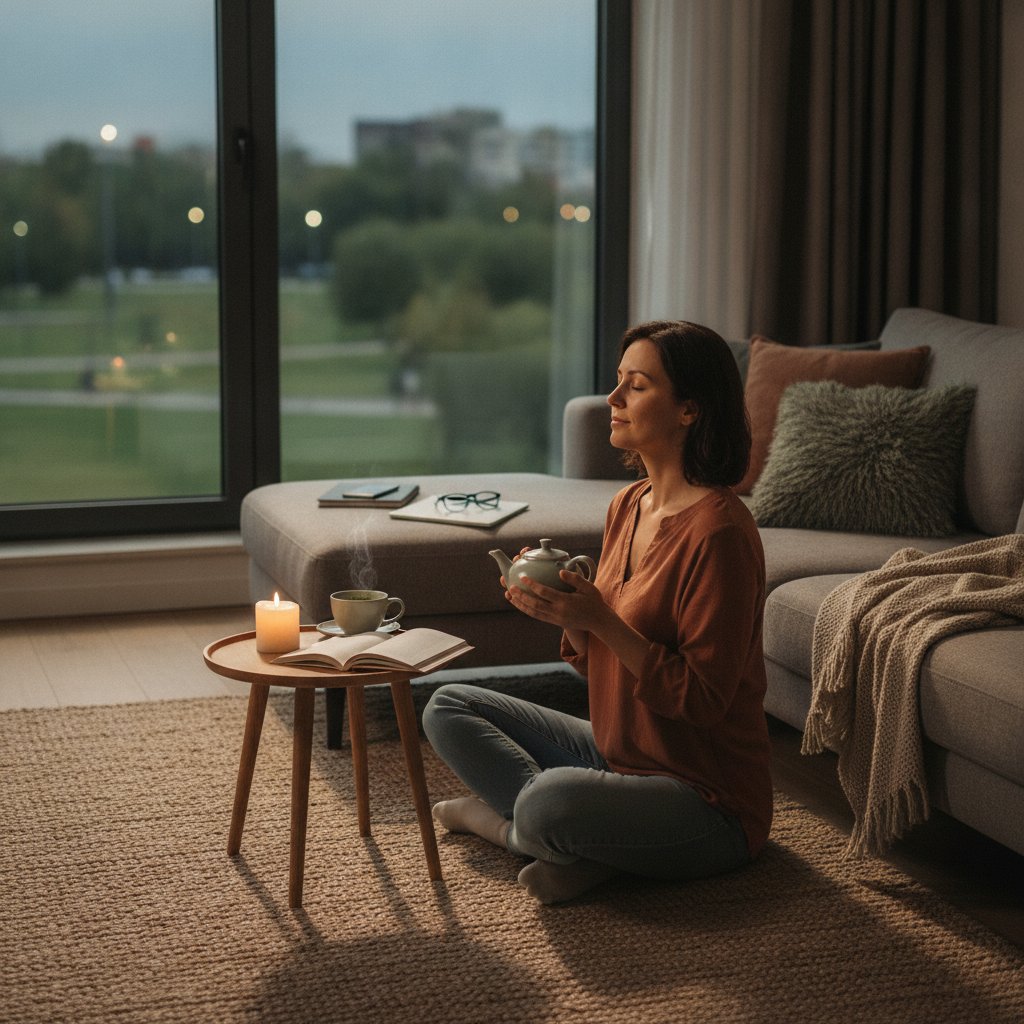
The boundary between work and rest has never been more porous, and most people feel it acutely by the time evening arrives. The laptop stays open past dinner, the work email refreshes one more time, and what should have been a genuine off-hour quietly becomes an extension of the professional day. This erosion isn't a matter of poor discipline — it's a structural problem, one that responds well to a structural solution. When an evening is designed around a single, deliberate transitional activity, something shifts. The nervous system gets a clear signal, the mind begins to release its grip on unfinished tasks, and rest becomes something that actually arrives rather than something chased.
What Makes a Transitional Activity Different From Just Relaxing?
The distinction matters more than it might appear. Relaxing — scrolling through a phone, sitting in front of a television without intention, grazing through the kitchen — tends to be passive and often ambiguous in its effect. A transitional activity, by contrast, carries a kind of ritualistic weight. In many East Asian cultural traditions, the concept of *ma* (間) — often translated as negative space or meaningful pause — describes the deliberate gap between one state and another that gives each state definition. A transitional activity functions similarly: it creates a seam in the day, a moment the mind can recognize as a threshold. Walking a fixed route through a neighborhood like Portland's Ladd's Addition, brewing a specific tea, or sitting with a journal for twenty minutes are all examples. The activity itself matters less than its consistency and its signal value.
Consistency is where the mechanism becomes clear. When the same activity anchors the transition from work to evening night after night, the brain begins to associate it with a shift in mode — a process psychologists sometimes describe as a conditioned response, though the practical experience of it is far less clinical. The activity becomes a door. Before it, the day still belongs to work. After it, it belongs to something else entirely. This is why a single activity outperforms a vague intention to relax after dinner: intention alone doesn't create that seam. The ritual does.
How Does the Body Recognize the End of the Day?
Biologically, the body relies on cues. Light shifts at dusk, mealtimes signal progression through the day, and physical patterns — a commute, a change of clothes, the closing of an office door — have historically marked the transition from productive hours to restorative ones. Remote work and flexible schedules have dismantled many of those cues without replacing them. What fills the gap is often just more screen time, which confuses rather than clarifies the body's internal clock. A chosen transitional activity steps in to perform the role those environmental cues once played. It doesn't need to be long — thirty minutes is often sufficient — but it needs to carry enough sensory or physical distinctiveness that the body registers it as meaningful.
Practical examples cluster into a few broad categories. Physical movement is among the most reliable: a walk without headphones, a short yoga sequence, or even a few deliberate minutes of stretching on a balcony. Creative or absorptive activities — sketching, cooking a new recipe with focused attention, working through a passage in a book — also function well because they redirect cognitive engagement without sustaining the same kind of alert, problem-solving mode that work demands. Apps like Calm or Headspace have built entire product categories around this need, offering guided sessions specifically positioned as end-of-workday rituals. What those tools understand, and what the research broadly supports, is that the transition itself is the product — not the meditation, not the walk, but the reliable shift they produce.
Why One Activity Outperforms a Complex Evening Routine
There's a cultural tendency to treat wellness as a sequence of optimized behaviors — a multi-step evening routine involving specific supplements, blue-light glasses, journaling, breathwork, and a curated playlist. The appeal is understandable, but the complexity often becomes its own form of low-grade stress, especially after a demanding day. The French have a useful expression: *art de vivre*, or the art of living, which implies not a maximized checklist but a cultivated ease with the rhythms of daily life. A single transitional activity embodies that principle more faithfully than a structured evening protocol does. When you strip the ritual down to one thing, it becomes sustainable in a way that five things never quite are.
Simplicity also removes the decision-making load from the end of the day, when that capacity is already depleted. Knowing that the evening begins with a particular walk, a specific tea preparation, or twenty minutes of reading eliminates the nightly negotiation with yourself about what to do first and how long each thing should take. The single activity serves as an anchor — a term borrowed from behavioral economics, where it describes a fixed reference point that structures subsequent choices. Once the anchor is in place, the rest of the evening tends to organize itself more naturally around genuine rest rather than restless half-activity.
The evening, understood this way, isn't something that happens after work ends — it's something that has to be initiated. The difference between those two framings is more consequential than it sounds. Waiting for work mode to lift on its own often means it never quite does; the residue of the day lingers in the background of whatever comes next. But when an evening is consciously opened by a specific, chosen activity — one that you return to reliably, that carries its own texture and rhythm — the transition becomes real. The same broad observation holds here as it did at the start: the boundary between work and rest is a structural problem, and it yields to a structural solution. One activity, chosen deliberately and practiced consistently, is enough to draw that line with surprising clarity.