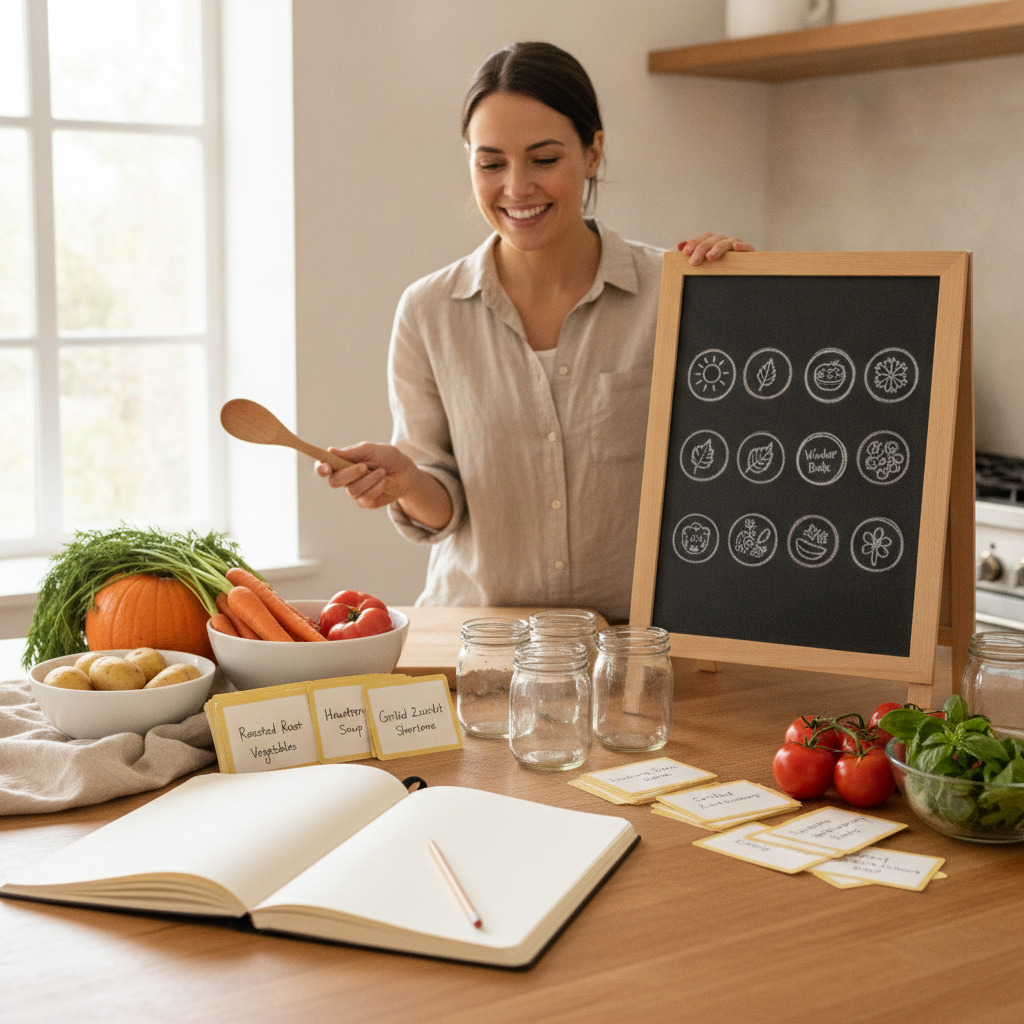
The question of what to eat is one of the most quietly exhausting decisions a person makes each day. It happens at the end of a long afternoon, when mental energy is already depleted, when the refrigerator offers possibility but no direction. It compounds across a week, a month, a year, until the sheer volume of small culinary choices begins to feel like a weight rather than a pleasure. The solution, it turns out, is not to think less about food — it's to think about it more deliberately, in advance, and far less often.
The Logic Behind a Bounded Recipe Collection
The concept of a bounded repertoire — a curated set of ten to fifteen core recipes tied loosely to the seasons — draws on something close to what psychologists call *satisficing*, a portmanteau of satisfying and sufficing that describes the practice of choosing a good-enough option rather than endlessly optimizing. A home cook who has internalized fifteen reliable recipes doesn't spend Tuesday evening browsing Bon Appétit or scrolling through Serious Eats looking for inspiration. Instead, they reach for a known quantity: the roasted chicken thighs that come together in forty minutes, the lentil soup that practically makes itself, the sheet-pan vegetables that adapt to whatever is cheap and fresh at the market that week. The decision has already been made, in a quieter moment, when the stakes were low.
This kind of pre-commitment doesn't diminish the pleasure of cooking — it tends to deepen it. When a person isn't scrambling to locate a recipe, source unfamiliar ingredients, or mentally convert tablespoons into grams under pressure, they can actually pay attention to what they're doing. They notice the way garlic softens in olive oil, the moment when onions shift from sharp to sweet. Familiarity with a recipe creates the cognitive space for real presence in the kitchen, which is itself a form of rest.
Seasonality as a Natural Rotation Mechanism
One of the quiet virtues of anchoring a meal repertoire to the seasons is that it solves the variety problem without requiring deliberate effort. A repertoire built around what's genuinely available — asparagus and snap peas in spring, tomatoes and corn through summer, squash and root vegetables come autumn, hearty braises and dried legumes through winter — naturally rotates across the calendar year. The cook doesn't need to engineer novelty because the ingredients themselves bring it. A simple grain bowl that uses farro in October looks and tastes entirely different when built around spring radishes and pea shoots in April, even if the technique and proportions stay the same.
Markets like Whole Foods or a well-stocked neighborhood co-op make seasonal produce legible through signage and placement, but the more reliable guide is a standing weekly visit to a farmers market, where whatever's piled highest and priced lowest is almost always the right answer. Over time, this kind of seasonal attentiveness becomes its own form of local knowledge — an understanding not just of what to cook, but of when, and why certain combinations feel right at certain times of year.
Building the Repertoire With Intention
Constructing a seasonal repertoire isn't a matter of picking fifteen favorites and calling it finished. It requires a kind of editorial thinking — balancing proteins, accounting for nights when time is genuinely short, including at least a few dishes that can be made almost entirely from pantry staples when a week goes sideways. A well-designed repertoire tends to include three or four anchor dishes that carry the week's heaviest nutritional and practical load, a handful of lighter or quicker preparations for busy evenings, one or two dishes that feel genuinely celebratory without being technically demanding, and a reliable formula for using up what's left before the next shopping trip. Apps like Paprika or Mela are useful for organizing these collections digitally, though a hand-annotated index card box on the counter works just as well and carries its own particular satisfaction.
The ten-to-fifteen range is not arbitrary. Fewer than ten and the repertoire begins to feel constrictive; more than fifteen and the cognitive overhead of maintaining familiarity with each dish starts to erode the original benefit. Within that range, a cook develops something close to what culinary traditions call *mise en place* — literally "everything in its place" — but applied not just to a single meal's preparation, but to the entire architecture of how they feed themselves and the people around them.
When Repetition Becomes Ritual
There's a cultural dimension to this kind of cooking that deserves acknowledgment. Many of the world's most nourishing food traditions are built not on endless variety but on a relatively small number of deeply understood preparations, made repeatedly and refined across generations. French *cuisine bourgeoise* — the honest, home-based cooking that forms the backbone of French domestic life — is essentially a repertoire tradition. So is the Japanese concept of *ichiju sansai*, meaning "one soup, three sides," a structural framework that generates endless variation within a stable form. These traditions weren't born from laziness or limitation. They reflect the understanding that mastery and comfort, both in the kitchen and at the table, come from depth rather than breadth.
Returning to the same dishes across seasons and years isn't culinary monotony — it's the slow accumulation of a personal cooking vocabulary, one that eventually allows a person to improvise with confidence rather than anxiety. The cook who has made a simple pasta with olive oil, garlic, and whatever greens are in the refrigerator fifty times knows something that no recipe can fully teach.
The quiet exhaustion that arrives with the evening question of what to eat doesn't disappear on its own. But when the answer already exists — already tested, already trusted, already waiting — what was once a minor daily burden becomes something closer to comfort. The decision was made in a calmer moment, and tonight, it simply holds.