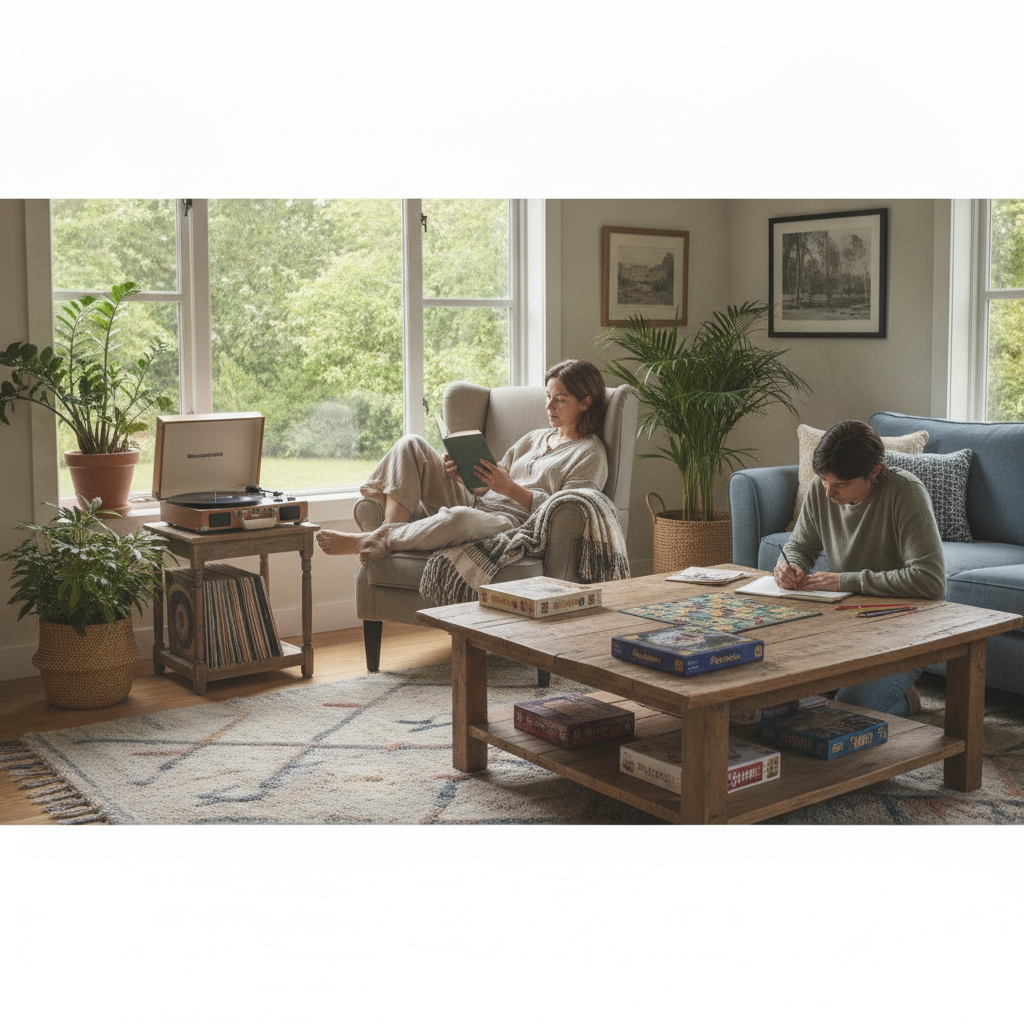
Most homes in 2026 are, in practice, fully saturated with screens — not because anyone planned it that way, but because each device arrived with a reasonable justification and quietly colonized a little more of daily life. The television came first, then the laptop migrated from the office to the couch, then the phone became a permanent presence on every surface. What no one quite anticipated was how thoroughly this accumulation would reshape the texture of rest itself, turning what once felt like downtime into something closer to low-grade consumption on a loop.
The experiment of designating one room — a bedroom, a reading nook, a rarely-used dining room — as completely screen-free for three weeks sounds simple enough to be almost dismissible. It doesn't require an app, a subscription to a wellness platform like Calm or Headspace, or a weekend retreat to a place like Esalen. It requires only that one space in the home be held to a single constraint. And yet the effects tend to arrive not with dramatic revelation but with a quieter, more disorienting quality: the sudden awareness of how rarely anyone in a modern household actually experiences unmediated stillness inside their own walls.
What Happens in the First Week
The first week of a screen-free room is, for most people, mildly uncomfortable in ways that feel disproportionate to what's actually being asked. Walking into a room and not reaching for a phone — not checking a notification, not pulling up a podcast — exposes just how reflexive the reaching had become. The discomfort isn't boredom in any classical sense; it's closer to what psychologists who study attention call *attentional residue*, the difficulty of being fully present in a space when the pull of another context is just a pocket away. The room itself starts to feel different simply because it's being encountered without the buffer of a screen mediating the experience. Sounds from outside become noticeable. The quality of afternoon light across a wall registers in a way it hadn't before. Small physical details of the space — the texture of a chair, a book left on a shelf, the faint smell of wood or old fabric — surface back into awareness.
This initial phase is less about relaxation than about recalibration. The nervous system, accustomed to a near-constant stream of visual and auditory input, takes time to shift registers. Some people find themselves sitting in the screen-free room for five or ten minutes feeling genuinely at a loss, which is itself a revealing signal. The loss isn't of entertainment — it's the loss of a default behavior so ingrained it had ceased to feel like a choice at all.
The Middle Shift and What It Reveals
By the second week, something begins to change. The room stops feeling like a deprivation zone and starts functioning more like what it was probably always meant to be: a place to simply inhabit. People who use bedrooms as their screen-free space often notice that sleep quality shifts, not because screens are absent at bedtime specifically, but because the room itself has been reconditioning a different set of associations. The Japanese concept of *ma* — the meaningful quality of empty space, the pause that gives surrounding activity its shape — becomes experiential rather than abstract. When a room isn't also a theater or a workstation or a social media terminal, it begins to accumulate a different kind of atmosphere, one that the body recognizes and responds to before the mind quite catches up.
Activities that feel slightly effortful in screen-saturated environments start to feel natural in this one. Reading stretches longer. Conversations, when they happen in the space, tend to run deeper and slower. Handwork — sketching, journaling, knitting, even just folding laundry without something playing in the background — takes on a different quality. The French phrase *farniente*, literally "doing nothing," captures something of this: the idea that genuine rest isn't inactivity but a particular quality of presence, undemanded and unhurried.
How the Default Begins to Shift
The three-week mark is where the more lasting change tends to announce itself, and it does so less in the screen-free room than outside of it. The default posture toward downtime — the automatic reach, the reflexive opening of an app, the background noise conjured to fill any silence — starts to feel less inevitable. Having spent several weeks regularly experiencing a different mode of rest, the nervous system begins to hold two options simultaneously rather than one. Screens don't disappear from the rest of the home; the change isn't evangelical. But the relationship becomes more chosen and less compulsive, which is a meaningful distinction.
People who've run this experiment in their own homes often describe it in terms of reclaiming a certain quality of time they hadn't realized they'd lost. The afternoon that once vanished into a scroll becomes something that can, sometimes, be spent differently — sitting in a particular chair by a window, or on a porch, or at a kitchen table with a cup of coffee and nothing else demanding attention. The screen-free room functions, in this sense, as a kind of rehearsal space for a different relationship with leisure, one that gets practiced until it becomes available in contexts beyond the room itself.
If you're considering this experiment, the room you choose matters less than the commitment to hold it consistently for the full three weeks. A spare bedroom works. So does a breakfast nook or a sunroom. What matters is that the space becomes genuinely associated with a different quality of experience — that when you walk in, something in you recognizes the invitation to simply be there, without agenda, without a screen mediating what that means. The first week will feel strange. The third week will feel like something you didn't know you were missing. And the texture of your evenings — not just in that room, but throughout the house — will quietly begin to reflect the difference between rest that's chosen and rest that's merely defaulted into.