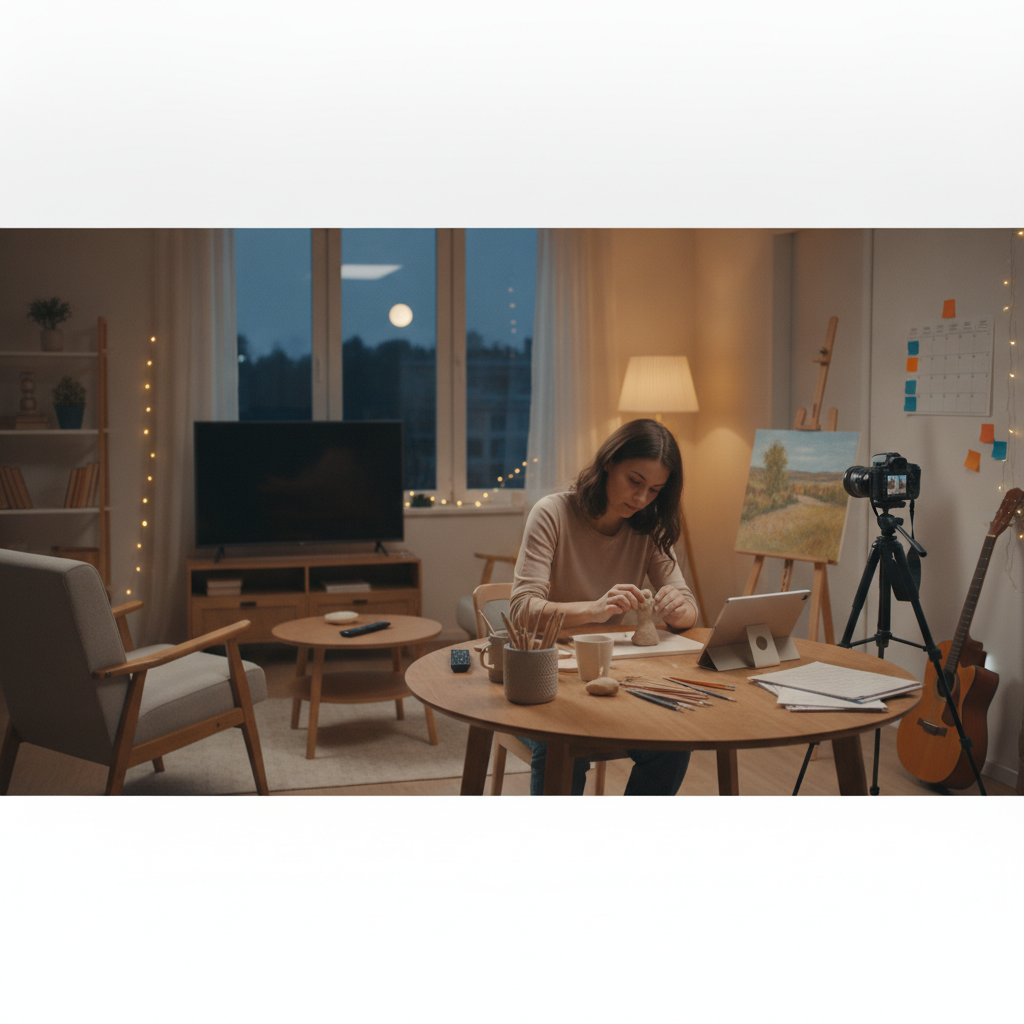
There is a particular quality to the end of a weekday evening — that soft, directionless stretch of time after dinner has been cleared and the obligations of the day have technically concluded. For many people, this hour resolves itself automatically, almost without decision: a streaming service opens, a phone is picked up, a familiar scroll begins. The choice isn't made so much as it simply happens, the path of least resistance leading exactly where it always does. What's curious isn't the behavior itself, but what accumulates in its absence when something else — something constructive, rotating, and intentionally chosen — quietly takes its place over the course of a month.
The Psychology of Perceived Progress in Everyday Life
Humans are not particularly good at measuring their own growth in real time. Progress tends to be invisible until it isn't — until a piece of furniture gets assembled without consulting the instructions twice, or until a sourdough loaf actually rises the way it was supposed to. Psychologists and behavioral researchers have long observed that the subjective feeling of forward momentum matters enormously to a person's sense of wellbeing, sometimes more than the objective outcome itself. This concept, sometimes called *self-efficacy* (a person's belief in their capacity to influence events in their own life), builds through small, repeated demonstrations of competence. A single weeknight hour, redirected with intention, becomes a surprisingly reliable generator of that feeling — not because the skill being practiced is extraordinary, but because the act of practicing anything tangible produces a trace that passive entertainment simply doesn't leave behind.
The distinction worth drawing here is between consumption and creation, or more precisely, between receiving and doing. Watching something well-made, whether on Netflix or a YouTube channel dedicated to woodworking techniques, is a form of pleasure — real, legitimate, and not inherently harmful. But it leaves no residue of capability. A person emerges from an hour of television more or less the same person who sat down. An hour of practicing watercolor washes, learning basic chord transitions on a guitar found in a closet, or working through a beginner Japanese lesson on Duolingo deposits something small but real into what might be called a personal competence ledger. Over four weeks, those deposits become legible.
Why Rotation Matters More Than Commitment to One Skill
The instinct, when deciding to use evening time more intentionally, is often to pick one skill and commit to it seriously — to treat the hour like a mini-course with a trajectory and a measurable endpoint. This approach is reasonable, but it tends to stall around the second week, when the novelty of the new activity has worn off and the drudgery of early-stage incompetence begins to dominate the experience. Rotation — cycling through two or three loosely related or entirely different activities across the weeks — solves this problem in a somewhat counterintuitive way. Rather than deepening one skill continuously, it broadens a person's sense of their own capacity, which in turn sustains motivation across the month more effectively than linear progress in a single domain.
A practical rotation might look something like this: one week of basic cooking technique practice using a resource like the YouTube channel *Ethan Chlebowski*, followed by a week of sketching from reference images using a sketchbook from a local art supply shop, followed by a week of learning a short piece on a keyboard. None of these need to reach any standard of proficiency. The point is engagement — the activation of attention in service of doing rather than watching. What the brain registers, quietly, is that the same hour which once dissolved into passive reception is now producing recognizable results, however modest.
What Shifts After Thirty Days
The changes that accumulate over a month of this practice are subtle enough that they might be dismissed if a person isn't paying some attention. The most commonly reported shift isn't skill acquisition per se, but a recalibration of self-perception — a quiet but genuine revision of the internal story a person tells about what they do with their time. This matters more than it might initially seem. The way people narrate their own daily lives shapes what they believe they're capable of, and what they believe they're capable of shapes what they actually attempt.
There's also a secondary effect that tends to emerge around the third week: a mild but real impatience with the passive alternative. An evening that returns to old screen habits after several weeks of rotation can feel, for the first time, like a genuine loss — not a moral failure, but a missed opportunity. This isn't a manufactured guilt response; it's a recalibration of baseline expectation. The hour has been reframed, and reframing, once it takes hold, tends to be durable. Apps like *Notion* or a simple paper journal used briefly at the end of each activity session to record what was attempted can accelerate this shift by making the accumulation visible, which the brain needs in order to register progress it might otherwise overlook.
Making the Habit Stick Without Overcomplicating It
For you — if this is something worth trying — the setup matters less than the starting. One hour, one weeknight, something that requires your hands or your active attention. It doesn't need a plan beyond that for the first week. The rotation can be informal: whatever feels interesting enough to do instead of turning on a screen. Over time, a loose structure tends to emerge naturally, shaped by what held attention and what didn't. The month itself becomes a kind of low-stakes experiment in self-knowledge, revealing not just what you're capable of learning, but what you're actually drawn to when the path of least resistance isn't available.
What tends to happen is less dramatic than a transformation and more like a gentle reorientation. The evenings still end. The week still turns. But somewhere in the accumulated hours of doing something — anything — rather than simply receiving, a person begins to feel like someone who moves forward rather than someone who waits for the weekend. That feeling, modest as it sounds, is worth considerably more than one quiet hour of television.