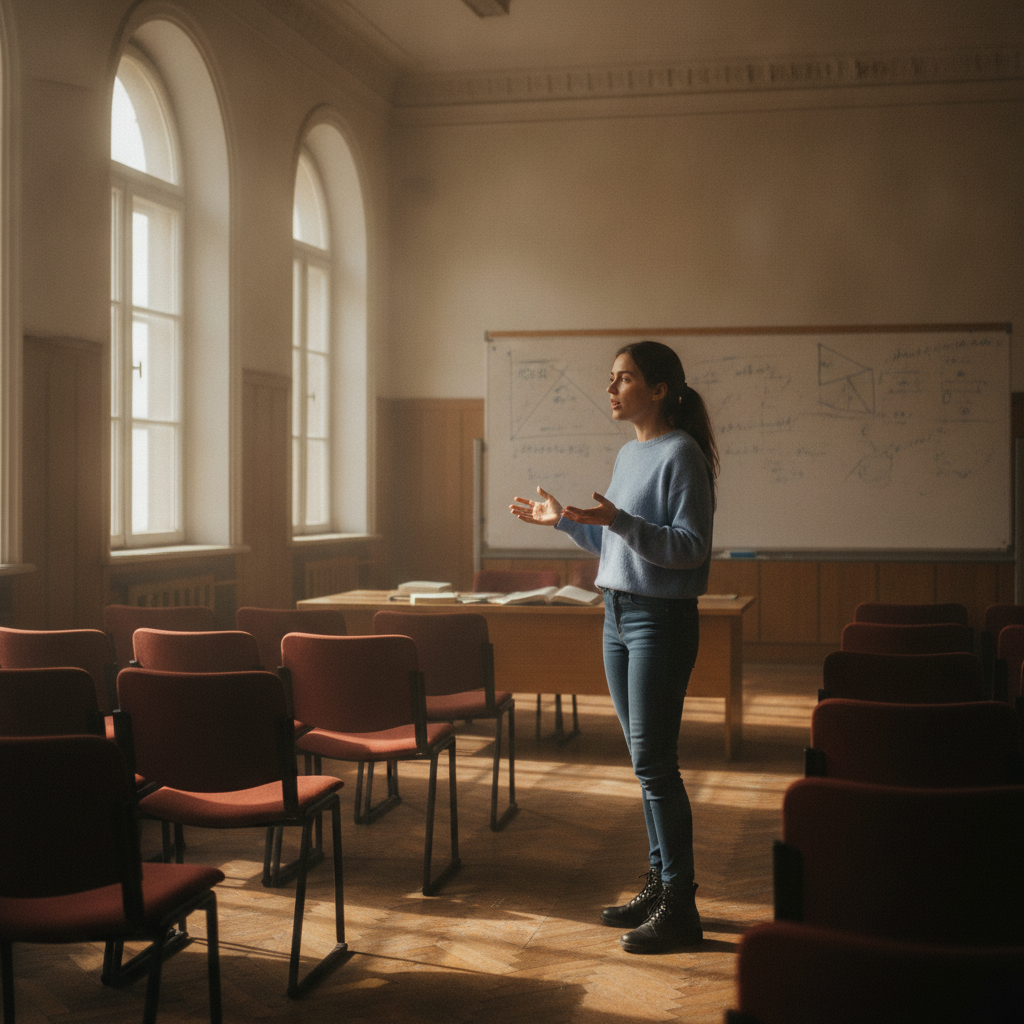
The act of speaking knowledge aloud — even when no audience is present — forces the brain to work in ways that silent review fundamentally cannot. Reading over notes feels productive, and in a narrow sense it is, but the cognitive effort involved is relatively shallow. The moment a learner opens their mouth and attempts to explain a concept from memory, the process shifts from recognition to genuine reconstruction, and that shift is where durable understanding begins to form.
The Gap Between Recognition and Reconstruction
Silent review relies heavily on recognition — seeing familiar material and registering it as known. Reconstruction is a far more demanding process, requiring the learner to retrieve, sequence, and articulate information without the page acting as a prompt. When someone tries to explain a concept out loud, any gap in understanding becomes immediately audible. The hesitation, the vague phrasing, the circular sentence that never quite lands — these are diagnostic signals that no amount of passive rereading would have surfaced. Reconstruction forces honesty that recognition quietly avoids.
How Speaking Activates Multiple Cognitive Channels
Verbalizing an explanation engages language processing, working memory, and conceptual organization simultaneously. Unlike reading, which processes information along a relatively linear path, speaking requires a learner to hold an idea in mind, translate it into words, monitor whether those words are accurate, and adjust in real time. This multi-channel demand creates stronger memory encoding because the brain forms more associative pathways around the material. Apps like Anki are often used to support retrieval practice, but the spoken explanation method adds a production layer that card-flipping alone doesn't require. The output itself is the training.
The Role of Auditory Feedback in Self-Correction
Hearing one's own explanation introduces a feedback loop that silent study cannot replicate. When a concept sounds unclear spoken aloud, it almost always is unclear — and the learner hears that directly, without needing a teacher or study partner to flag it. This auditory self-monitoring mirrors the process educators at institutions like the Khan Academy have long emphasized: the act of teaching, even to oneself, compresses the distance between surface familiarity and actual mastery. A learner who stumbles mid-explanation has, in that moment, identified a gap more precisely than any practice test question might have revealed.
Empty Room Practice as a Low-Stakes Retrieval Method
One advantage of explaining to an empty room — as opposed to a study partner or a peer group — is the complete absence of social pressure. Without an audience, learners can talk through half-formed ideas, restart explanations, and use informal language without self-consciousness. Tools like Notion or simple voice memo apps on a phone can supplement this by allowing learners to record and replay their own explanations, creating a secondary layer of review. The empty room removes the performance element entirely, making it easier to practice honestly rather than practicing to impress. That honesty is precisely what makes the method effective.
Why Silent Review Feels More Efficient Than It Is
Silent review is seductive because it generates what researchers call fluency illusions — the sensation of knowing material because it looks familiar on the page. The brain interprets visual familiarity as understanding, which it isn't. A student who reads the same chapter three times may feel prepared but will often struggle when asked to reproduce the concept in their own words or apply it to an unfamiliar problem. This is why students who rely only on highlighting and rereading tend to underperform relative to the effort they've invested. The effort feels high; the encoding depth is low. Spoken explanation breaks that illusion by demanding production, not just perception.
Building the Habit Into a Practical Study Routine
Making out-loud explanation a consistent part of your study routine doesn't require elaborate setup. After finishing a reading or a lecture segment, close your notes, stand up if possible, and explain what you just learned as though you were summarizing it to a curious friend. Use informal language — precision comes later. When you hit a point where the words stall, mark it mentally or jot a quick note, then return to the source material specifically to fill that gap. Some learners find it helpful to structure these explanation sessions around a timer, using blocks of ten to fifteen minutes per concept, a rhythm that pairs naturally with tools like the Pomodoro Technique. Over time, the gaps get smaller, the explanations get cleaner, and the understanding beneath them becomes significantly more stable.
Speaking knowledge aloud to an empty room might look unconventional from the outside, but the cognitive process it activates is anything but trivial. It converts passive familiarity into active ownership, makes gaps in understanding visible before they become exam-day surprises, and builds the kind of durable recall that survives time, pressure, and unfamiliar contexts. Silent review has its place, but as a sole strategy it asks too little of the learner. Explanation — spoken, honest, and imperfect — asks exactly enough.