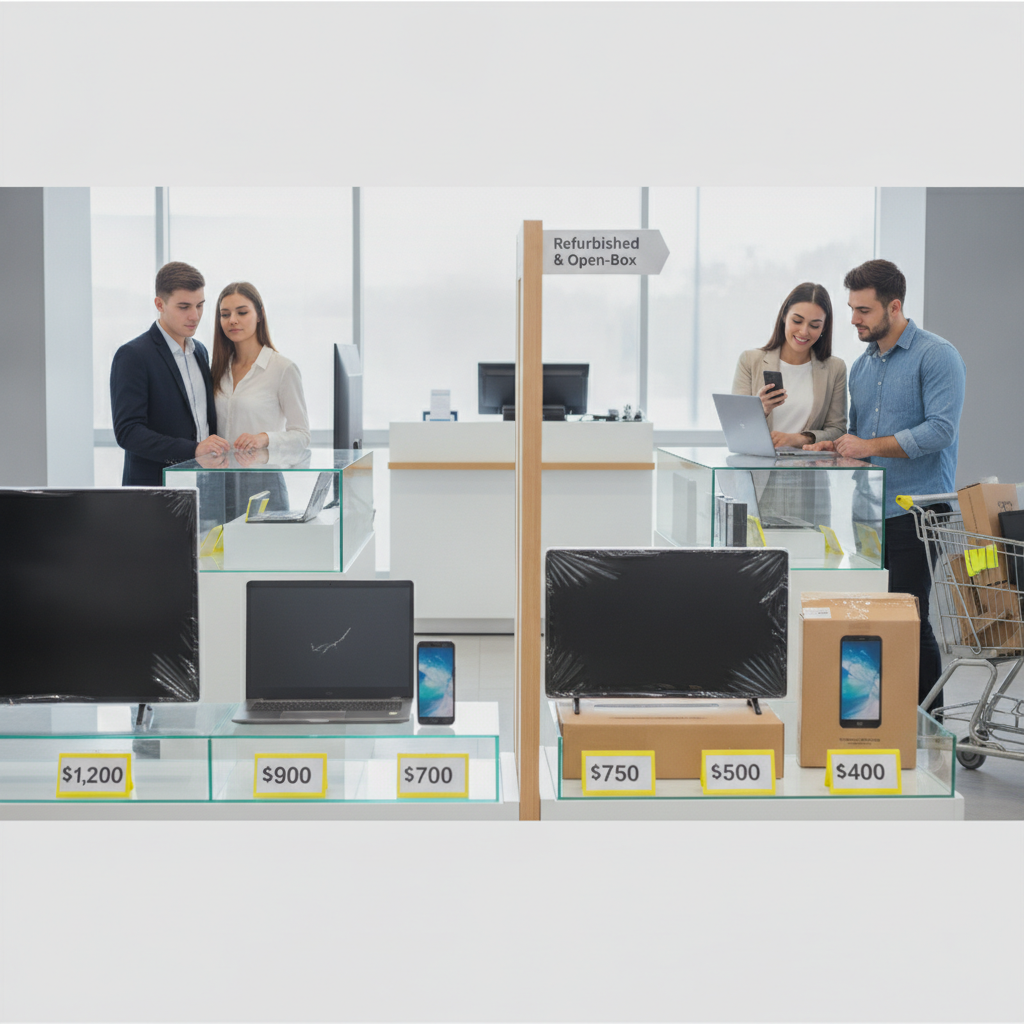
Most shoppers arrive at the electronics section of a store — or the checkout page of an online retailer — with a single number in mind: the full retail price listed on the tag. That number becomes the reference point for everything else. What frequently gets overlooked is that a parallel market of open-box and certified refurbished products sits just adjacent to that retail world, often offering the same core hardware at a meaningfully lower cost. The gap between what buyers pay and what they could pay is rarely discussed at the point of sale, and that silence is expensive.
How Open-Box and Certified Refurbished Products Actually Differ
The terms "open-box" and "certified refurbished" are often used interchangeably, but they describe distinct product conditions. An open-box item is typically a unit that was returned by a customer with minimal or no use — the packaging was opened, the item was briefly handled, and it was returned to inventory. A certified refurbished product, by contrast, has gone through a more formal process: it's been inspected, repaired if necessary, cleaned, and restored to manufacturer or retailer standards. Both categories carry risk profiles that are meaningfully lower than the stigma attached to the word "used" would suggest, but understanding the distinction matters when comparing prices.
The Refurbishment Programs Behind Major Brand Names
Several large electronics manufacturers operate their own certified refurbishment programs, and these programs carry more weight than a third-party seller simply relabeling a returned product. Apple's Certified Refurbished store, for example, replaces outer shells and batteries on applicable devices, includes standard warranties, and ships units in new packaging. Samsung and Dell run comparable programs with their own grading systems and warranty terms. These programs exist because the brands have a reputational stake in the quality of every product sold under their name — refurbished or otherwise. That accountability changes the risk equation for buyers in a concrete way.
Where the Price Gap Shows Up Most Clearly
The value difference between retail and certified refurbished pricing tends to be most visible in categories with high sticker prices: laptops, tablets, smartphones, and televisions. A flagship laptop that retails new for several hundred dollars often appears in certified refurbished listings at a discount that represents genuine savings, not cosmetic markdown theater. The gap is less pronounced on entry-level or commodity electronics, where retail margins are already thin. Retailers like Best Buy also maintain their own open-box sections in-store, often with tiered condition labels — Excellent, Satisfactory, and similar designations — that help buyers calibrate expectations before purchasing.
What Warranties and Return Windows Actually Look Like
One of the more persistent reasons buyers default to full retail pricing is a belief that refurbished and open-box products offer no recourse if something goes wrong. In practice, the warranty landscape is more varied than that assumption implies. Manufacturer-certified refurbished units from Apple or Dell typically include a standard one-year limited warranty — identical to what ships with a new unit. Open-box items purchased through major retailers often carry the retailer's standard return policy and, in some cases, the original manufacturer warranty if the original purchase date hasn't lapsed. Reading the warranty terms before checkout is the single most useful action a buyer can take in this category.
The Hidden Cost of Defaulting to New Without Comparing
Buying new electronics without checking certified refurbished options isn't just a missed savings opportunity — it's an uncalculated cost. When a buyer pays full retail without evaluating alternatives, they're implicitly deciding that the value of an untouched box outweighs the price difference. For some products and some buyers, that trade-off is reasonable. For many everyday purchases — a reliable laptop for remote work, a tablet for reading and browsing, a wireless speaker for a home office — the practical experience of using a certified refurbished unit is functionally indistinguishable from using a new one. The cost difference, over time and across multiple purchases, compounds in ways that are easy to underestimate at a single checkout.
Making the Comparison Before You Commit to a Purchase
Before finalizing any mid-to-high-cost electronics purchase, you should run a simple side-by-side comparison between new retail listings and certified refurbished options from the same manufacturer or a reputable retailer. Start with the manufacturer's own refurbished storefront, then check platforms like Back Market or Swappa, which specialize in graded used and refurbished electronics with their own buyer protections. Note the warranty terms, the return window, and the condition grade for each option. If the certified refurbished listing includes the same core warranty and a return policy you're comfortable with, the case for paying full retail price weakens considerably. This comparison takes less than ten minutes and has the potential to reshape how you approach electronics spending going forward.
The broader pattern here is one that tends to reward deliberate shoppers over impulsive ones. As manufacturer-run refurbishment programs expand and third-party platforms become more sophisticated in their grading and buyer protections, the quality floor for certified refurbished electronics will likely continue to rise. The value gap between retail and refurbished isn't shrinking — if anything, as flagship device prices climb, the spread between new and certified refurbished grows wider. Buyers who make comparison shopping a standard part of their electronics purchasing process are increasingly well-positioned to capture that gap rather than walk past it.