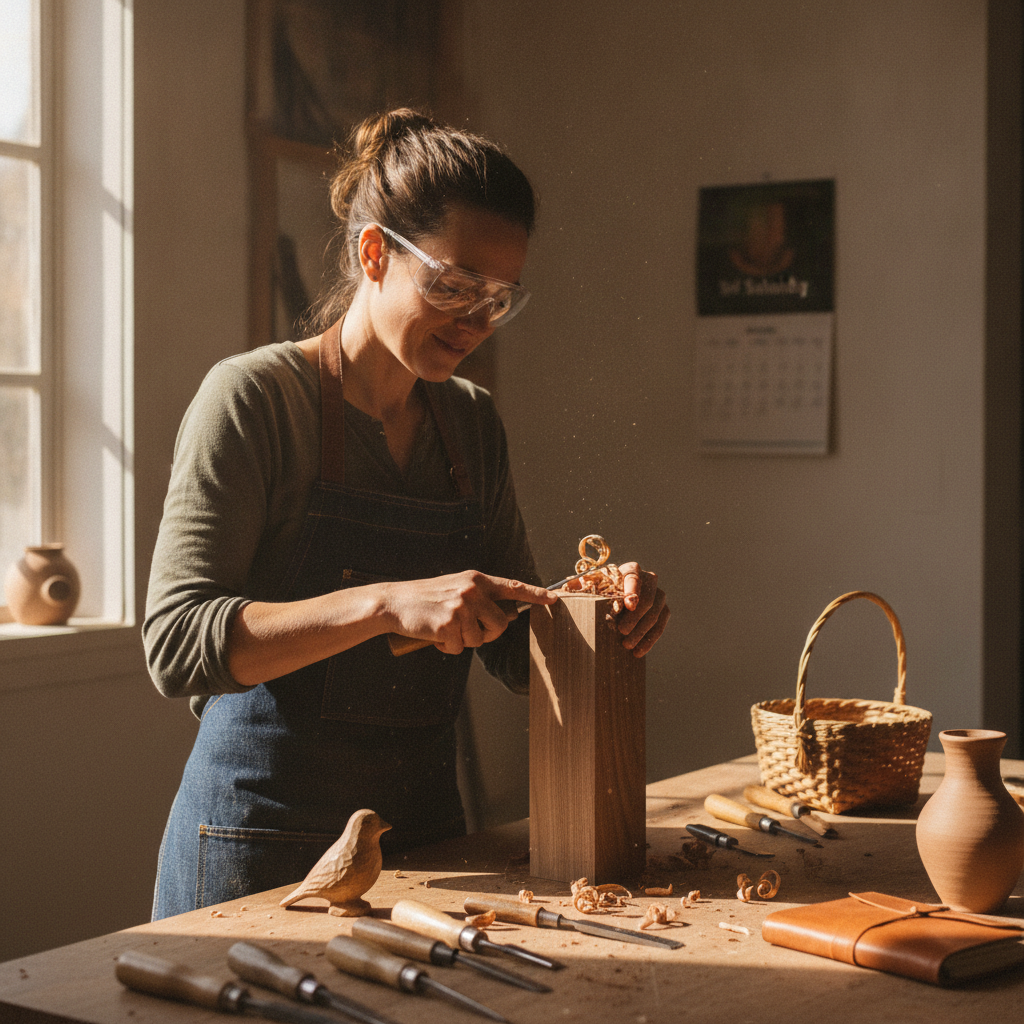
There is a particular kind of quiet confidence that arrives not from reading about something but from having made it with your hands. It shows up unexpectedly — while passing a hardware store, or watching someone knead bread dough at a market stall in Portland's Pearl District — as a small, settled recognition: *I know how to do that.* It is not the loud confidence of achievement. It is something more durable, rooted in the body rather than the mind, accumulated gradually across months of Saturday mornings given over to things that require touch, resistance, and material consequence.
What Tactile Learning Actually Does to the Sense of Self
The human nervous system learns differently when the hands are involved. Psychologists use the term *embodied cognition* — the idea that knowledge is not stored purely in abstract mental representations but is distributed across the body's muscle memory, sensory experience, and physical relationship with the world. When someone spends a morning learning to sharpen a knife properly, or learning the basics of hand-stitching leather, or coaxing a sourdough starter into something that actually rises, they are not simply acquiring a skill. They are reorganizing how they understand themselves in relation to physical challenge. The gap between knowing and doing — which can feel permanent in digital, screen-mediated learning — closes in a specific and memorable way. What once seemed opaque becomes legible through repetition and material feedback.
This is distinct from hobby culture, which tends to emphasize enjoyment and self-expression. The practice being described here is narrower and more deliberate: one morning per month, chosen with some intentionality, focused on something the hands can actually do wrong and eventually get right. The wrongness matters. The texture of failure — a joint that doesn't fit, a stitch that puckers, a weld bead that runs too hot — teaches in ways that no instructional video on YouTube or Skillshare can fully replicate. The correction comes from the material itself, not from an external evaluator, and that distinction changes the relationship a person has with their own competence.
The Seasonal Arc and Why a Month Is the Right Interval
A single morning of trying something tactile is interesting but not transformative. The transformation happens across a season — roughly three to four months — when a person can look back and count several distinct experiences of physical learning that have accumulated into a revised self-image. The monthly interval is important because it is close enough to maintain momentum and build a subtle sense of anticipation, but distant enough to allow each session to feel genuinely fresh rather than obligatory. Weekly practice tends to collapse into routine; monthly practice retains the quality of occasion.
Across a season, something interesting happens to the internal accounting of capability. The person who spent one morning in January learning to tie basic macramé knots at a community studio in Austin's East Side neighborhood, another in February working through the basics of caning a chair seat, and a third in March taking a beginner's intro to Japanese joinery at a local woodworking cooperative has not become an expert in any of these things. But they have quietly accumulated evidence — held in the hands and the body — that physical skills yield to patient attention. That evidence changes how the next unfamiliar task looks before it begins. The anticipatory dread that once accompanied anything requiring manual dexterity softens, not because the skill is already known but because the pattern of learning it has been demonstrated, repeatedly, to be survivable and even satisfying.
The Cultural Roots of Learning Through Making
Many traditional cultures embedded tactile learning into ordinary life not as enrichment but as survival. The Japanese concept of *shokunin* — loosely translated as craftsperson or artisan, but carrying a deeper connotation of lifelong devotion to the mastery of a single craft through daily practice — represents one formalized version of this. The German *Handwerk* tradition, which structured apprenticeships around the primacy of the made object, is another. In both cases, the underlying assumption is that the making of things with the hands is not a lower-order activity than intellectual work but a parallel and equally dignified form of knowledge production.
Modern life has largely disaggregated these traditions from everyday experience, replacing the tactile with the digital and the made with the purchased. The consequence, which registers less as a philosophical loss than as a vague restlessness, is a narrowing of the self's perceived range. Most adults in service-economy cities spend their weeks doing work that produces no physical artifact — nothing that can be held, tested against gravity, or shown to someone without a screen. The monthly tactile morning is not a romantic rejection of that reality. It is a modest, practical counterweight to it.
What Happens by the Fourth Month
By the time a fourth month arrives, the effect is less about any individual skill and more about what researchers call *self-efficacy* — a person's belief in their own capacity to execute tasks within a specific domain. In this case, the domain is broad: the physical world, in general, as a place where effort and attention produce results. The compound effect of several mornings spent in productive struggle with material — clay, wood, fiber, metal, dough — creates a revised internal model of what is learnable. Tasks that previously prompted an instinctive *I'm not someone who does that* begin to prompt something quieter and more open instead.
This shift shows up in small, practical ways that are easy to miss. A willingness to attempt a minor home repair rather than immediately calling for help. A comfort with asking a knowledgeable person at a local hardware cooperative like a Woodcraft store how something is actually done, without embarrassment. A patience when beginning something that will take time to feel natural. None of these are dramatic changes, but together they constitute a meaningful expansion of the territory a person inhabits — both literally and psychologically.
Making the Practice Sustainable
The month that tends to derail this kind of practice is not January or February, when resolutions carry their own momentum, but the third or fourth month, when the novelty has worn off and scheduling pressure reasserts itself. The most reliable protection against abandonment is to treat the morning as a constraint rather than a choice: the same approximate weekend, the same rough duration of two to three hours, booked into the calendar the way a dentist appointment is booked. The specific skill can rotate freely — and rotating it is part of what keeps the practice generative rather than repetitive — but the structure around it should be fixed.
It also helps to seek out contexts where learning happens alongside others. Community studios, cooperative workshops, local makerspace organizations like TechShop-style venues, and neighborhood cooking schools all provide something that solo learning at home cannot: the gentle accountability of shared attention, and the normalizing effect of watching other adults struggle cheerfully with something they don't yet know. These environments make the learning feel less like self-improvement and more like ordinary life, which is closer to what it actually is.
The person who began this practice in early spring — uncertain, slightly self-conscious about their inexperience with anything that required tools or patience — typically arrives at late summer with something they did not plan for: a quiet, grounded sense that the physical world is more navigable than it once seemed. Not because they have mastered it, but because they have spent several mornings inside it, failing in instructive ways, recovering, and making something that held together long enough to teach them what to try next. That accumulated evidence — stored in the hands, not just the mind — turns out to be a remarkably durable form of confidence.