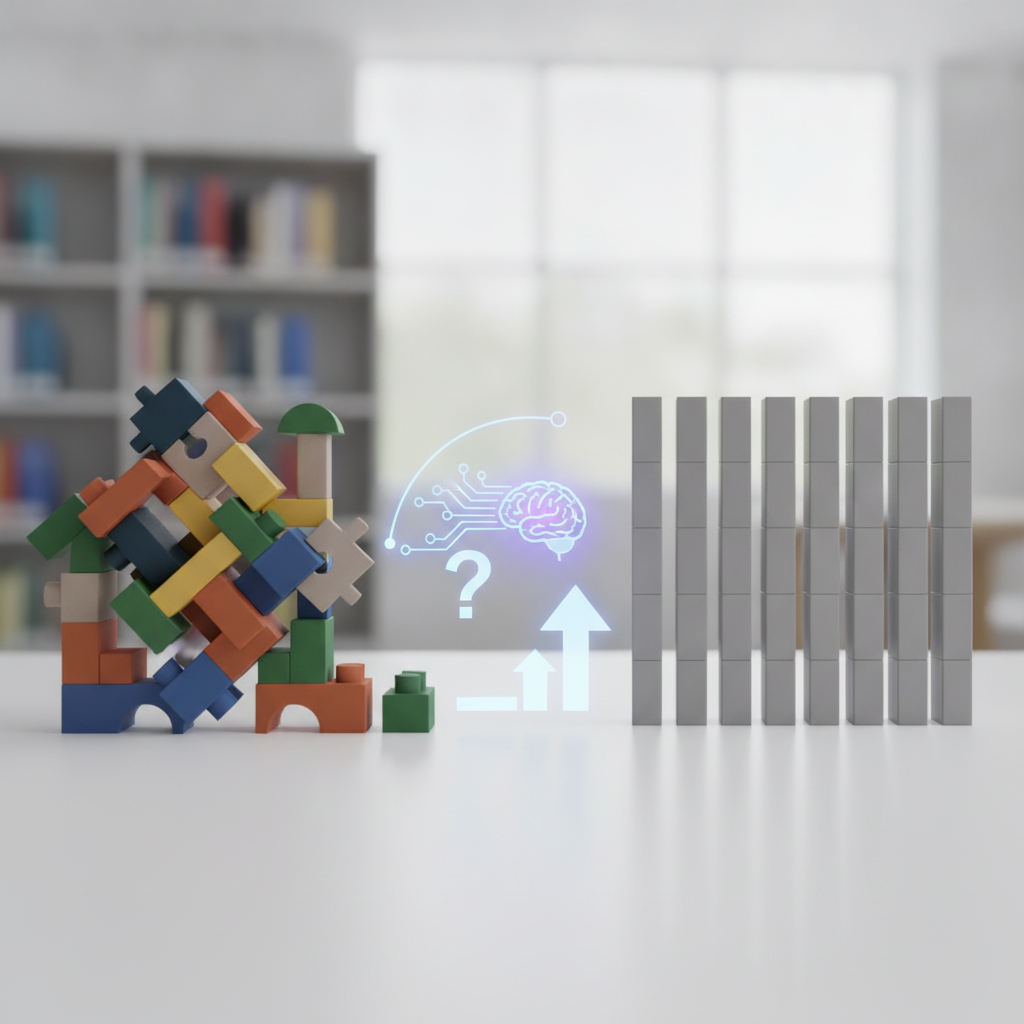
Most students approach learning the same way: master one topic completely before moving to the next. It feels logical, even responsible. But decades of research in cognitive science have consistently shown that this method — known as blocked practice — produces weaker long-term retention and poorer problem-solving performance than a less intuitive alternative called interleaved practice.
The Core Difference Between Blocking and Interleaving
Blocked practice means studying one skill or concept in a concentrated batch before switching to another. Interleaved practice, by contrast, mixes different topics or problem types within a single study session. A math student using blocked practice might spend an hour on derivatives, then an hour on integrals. One using interleaved practice would alternate between derivative problems, integral problems, and related rate problems throughout the same session. The experience feels messier and harder — and that difficulty is precisely the point.
Why Struggle Strengthens Memory Consolidation
The brain encodes information more deeply when it has to work to retrieve it. When problems of the same type appear back-to-back, learners quickly identify the pattern and apply it almost automatically. There's minimal retrieval effort involved. When problem types are mixed, the brain must first identify *which* strategy applies before solving anything. This extra cognitive step — called retrieval practice — forces stronger memory consolidation. Apps like Anki and platforms such as Khan Academy have built similar principles into their adaptive learning systems, recognizing that effortful recall outperforms passive review.
Interleaving and the Development of Discrimination Skills
One of the most important skills in any domain is knowing which tool to use for which problem. Blocked practice offers little opportunity to develop this ability, since the correct approach is always the same within a given set. Interleaved practice, however, constantly challenges learners to discriminate between problem types. A student working through biology on a platform like Coursera, for instance, must decide whether a given scenario calls for understanding cell division, protein synthesis, or enzyme function — before solving anything. This metacognitive layer builds a more flexible, transferable understanding of the subject.
The Performance Paradox Learners Often Misread
Interleaved practice produces a well-documented paradox: learners feel like they're performing worse during the session, even when they're learning more effectively. Blocked practice creates a sense of flow and competence because the same type of problem repeats. Interleaving feels choppy and uncertain by comparison. This gap between perceived performance and actual learning often causes students to abandon interleaving prematurely, convinced it isn't working. Research in educational psychology consistently shows that the opposite is true — performance on delayed tests favors interleaved learners by a meaningful margin, particularly when the test involves novel problem formats.
Subject Areas Where Interleaving Has the Clearest Impact
Interleaved practice shows particularly strong results in mathematics, foreign language acquisition, music training, and the physical sciences. In mathematics education, students who mix algebra, geometry, and statistics problems within one session outperform peers who study each topic in isolation, even when total study time is equal. Language learners benefit from interleaving vocabulary sets, grammar rules, and listening comprehension rather than drilling one category at a time. Musicians who practice scales, sight-reading, and repertoire within one session — rather than dedicating separate days to each — tend to develop more adaptive performance skills over time.
How to Build an Interleaved Study Routine That Actually Works
Shifting to interleaved practice requires some deliberate planning, but the structure doesn't need to be complicated. Start by identifying three to five distinct topics or problem types within a subject you're studying. Rather than working through all problems of one type before moving on, you rotate through each category in a set pattern — one problem from category A, then one from B, then one from C, then back to A. This rotation can be randomized for an added retrieval challenge, which tools like Quizlet's Learn mode or the scheduling features in Anki support naturally.
Keep sessions to a manageable length — roughly forty-five to sixty minutes works well for most learners. Shorter sessions reduce cognitive fatigue, which can otherwise muddy the benefits of interleaving. Give yourself brief pauses between rotations if needed, but resist the urge to cluster similar problems together just because it feels more comfortable. That discomfort is the mechanism doing the work.
Track your progress on delayed review tests rather than judging your performance within the session itself. The internal sense of struggle during interleaved practice is not a warning sign — it's the signal that deeper encoding is underway.
The Direction Educational Practice Is Heading
As learning science continues to influence curriculum design, interleaved practice is moving from an experimental concept into mainstream educational frameworks. Schools and universities are increasingly building mixed-problem sets into their assessments, and edtech companies are developing smarter algorithms that sequence content based on interleaving principles rather than simple topic progression. The growing adoption of adaptive learning platforms signals a broader shift in how structured practice is understood — less as a way to build comfort with individual skills, and more as a process of developing the flexible, context-sensitive thinking that real-world problem-solving actually demands. Learners who understand this shift early are better positioned to build study habits that hold up well beyond the next exam.