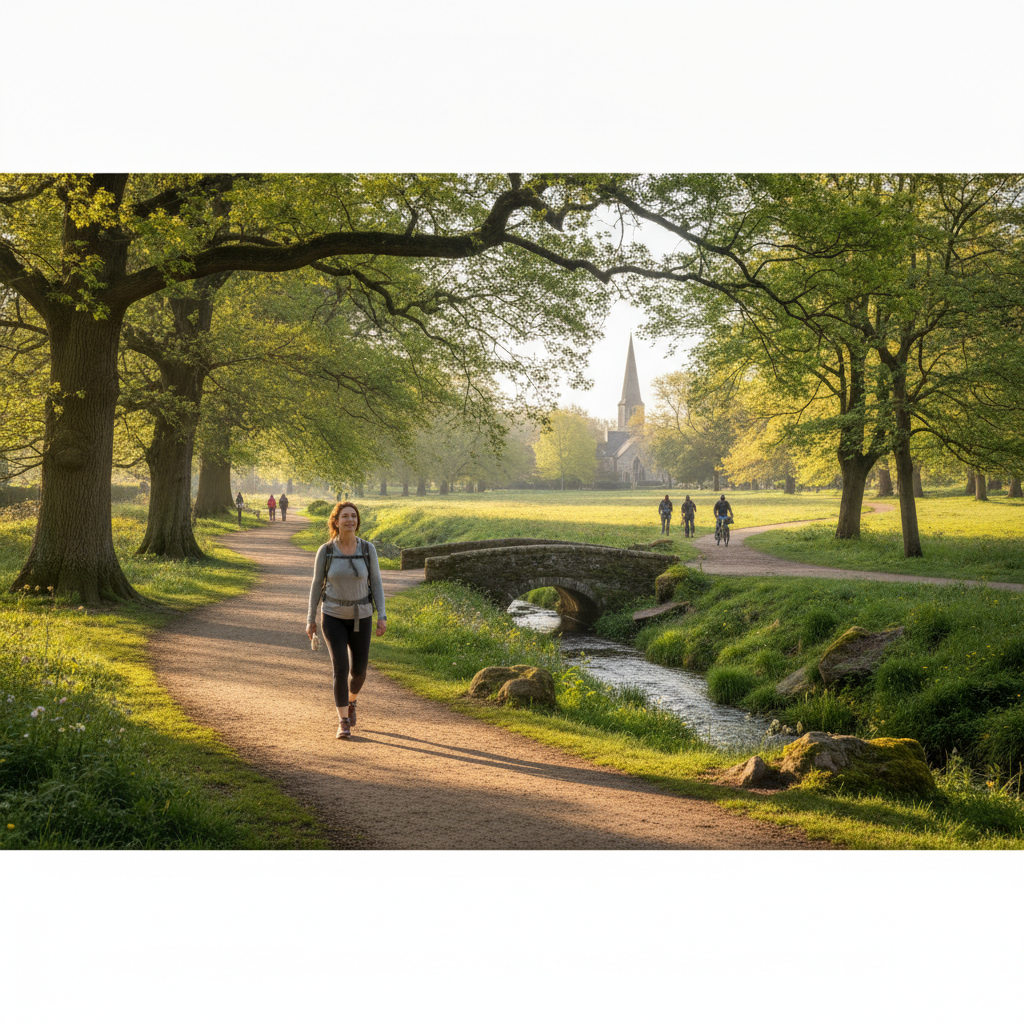
The mind clarifies itself most reliably not when it is told to be still, but when it is given a body in motion and a familiar world to move through. This is a truth that structured meditation and curated wellness apps have quietly obscured — that clarity is often a byproduct of rhythm, repetition, and ground beneath one's feet, not a product of controlled breathing in a darkened room. The weekend morning walk, taken consistently along the same route through the same local streets, is one of the oldest and most underrated cognitive tools available to anyone. It asks almost nothing and returns something difficult to manufacture any other way.
The Rhythm of Repetition and the Resting Mind
There is a concept in cognitive science sometimes called *default mode network activation* — the state in which the brain's background processing becomes most active when a person is not actively focused on external demands. Walking a familiar route engages the body just enough to regulate arousal without demanding conscious navigation, which is precisely the condition under which this deeper mental processing flourishes. The streets of a neighborhood like Portland's Hawthorne District or Chicago's Wicker Park, walked enough times to feel genuinely known, become a kind of external scaffold for the wandering mind. The familiar lamppost, the corner bakery that opens early, the particular quality of morning light on a brick wall — these fixed points anchor perception without consuming it. This gentle anchoring allows the mind to process unresolved problems, consolidate memory, and arrive at connections it would never reach through deliberate effort alone.
What Familiarity Does That Novelty Cannot
Much of the contemporary conversation around mental wellness emphasizes novelty — new experiences, varied stimulation, unfamiliar environments as a means of growth. There is genuine value in that framing, but it tends to crowd out an equally important truth: familiarity breeds a particular kind of cognitive ease that is not laziness but readiness. When a person walks the same Saturday morning route through their own neighborhood for several consecutive weeks, the route itself becomes almost invisible, and that invisibility is the gift. The mind is no longer occupied with orientation or evaluation; it is free. Apps like Calm or Headspace attempt to engineer this state through guided instruction, but a walk that has become second nature achieves it organically, without prompts or progress bars. The body knows where it is going, and the mind is left to do what it does best when left alone.
The Sensory World as a Thinking Partner
Outdoor walking engages what psychologists call *embodied cognition* — the deeply established connection between physical sensation and mental processing. The temperature of the air, the resistance of a slight incline, the sounds of a neighborhood waking up around seven in the morning — these sensory inputs are not distractions from thought but participants in it. There is a reason many of history's most productive thinkers were dedicated walkers: the sensory engagement of movement through a physical world does not compete with reflection, it enriches it. A route that passes a weekend farmers market, a quiet park bench, or a familiar independent coffee shop like a neighborhood café that has been open for twenty years provides not just scenery but a felt sense of belonging — and belonging, it turns out, is one of the more underappreciated conditions for clear, unclouded thinking.
Consistency as the Mechanism, Not the Constraint
The word *routine* often carries a slightly deflating connotation, as though consistency were the enemy of vitality. But in the context of cognitive health, routine is the mechanism through which the brain learns to trust that a particular window of time belongs to a particular kind of processing. When the Saturday morning walk becomes genuinely consistent — same approximate time, same general route, same low-stakes intention — the brain begins to anticipate it, to prepare for it, to arrive at that walk already primed for the kind of open, associative thinking that leads to genuine insight. This is the principle behind what some researchers describe as *implementation intention* — the way that linking a behavior to a specific context dramatically increases the probability of that behavior occurring and deepening over time. The walk does not need to be long. It does not need to cover impressive distance. It needs, above all, to be kept.
You Already Have Everything This Requires
If there is a case to be made for the weekend morning walk over more elaborate wellness practices, part of that case rests simply on accessibility. You do not need a subscription, a mat, a guided track, or a dedicated room. You need a pair of shoes and a route you know well enough to walk without thinking hard about where you are going. That route might pass through a part of your city you genuinely love — the stretch of older homes in a historic district, the waterfront path that catches the light differently in each season, the block where a small hardware store has occupied the same corner for forty years. These places do not need to be remarkable to be valuable. They need only to be yours, returned to regularly, walked with no agenda more demanding than presence. Over weeks and months, the cumulative effect of that simple commitment — that one quiet hour given back to the body and the mind on a Saturday or Sunday morning — tends to produce a quality of thinking that no app, no technique, and no indoor routine has yet managed to replicate.
The mind clarifies itself when it is given room to move, and room is most reliably found not in structured silence but in the easy, unhurried rhythm of a walk already known by heart.