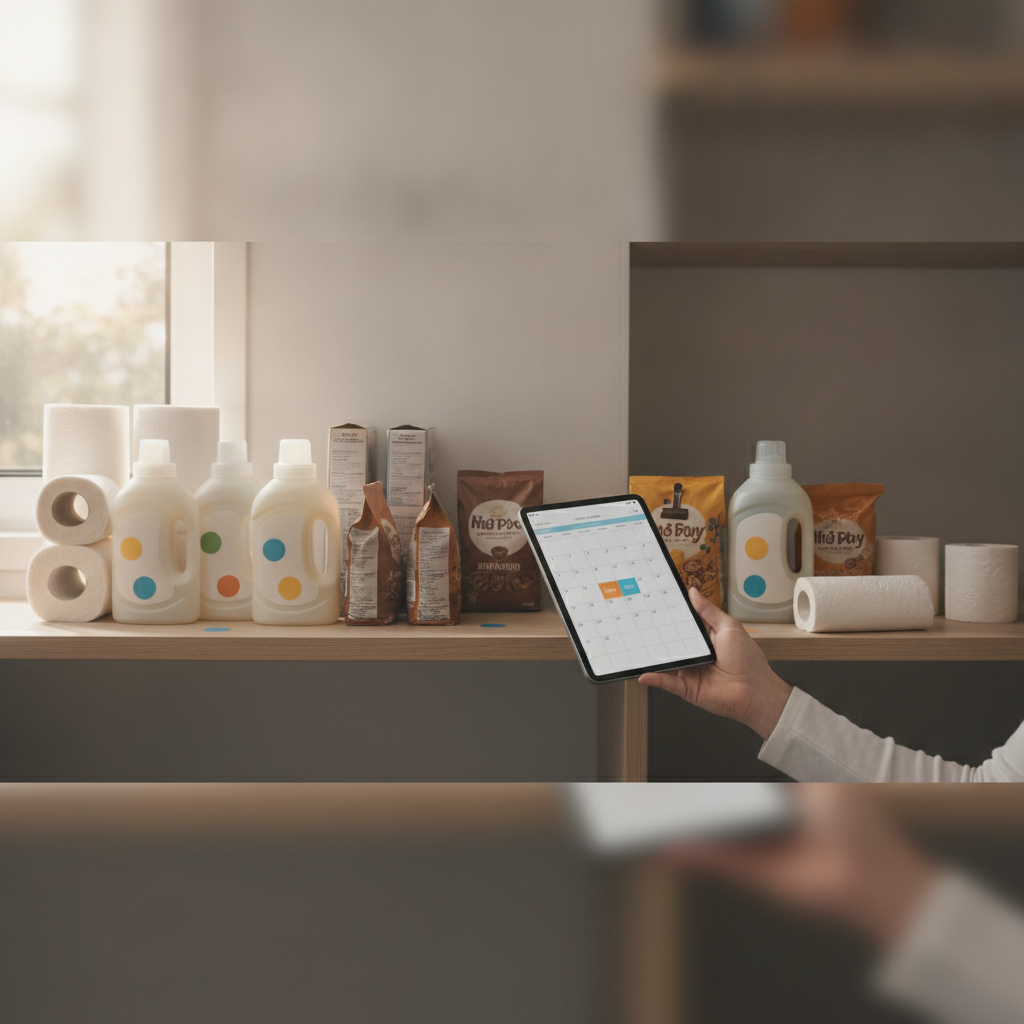
Most households spend more on everyday consumables than they need to — not because they're careless, but because they shop reactively. When a bottle of dish soap runs out or the last roll of paper towels disappears, the purchase happens at the least advantageous moment: full price, full urgency, zero flexibility. Shifting from reactive restocking to cycle-based purchasing changes the financial math considerably, and it doesn't require a warehouse membership or a garage full of inventory to make it work.
The Hidden Cost of Shopping When You Run Out
Reactive purchasing is one of the quietest budget leaks in a household. When supplies run low, there's no time to wait for a sale, compare unit prices, or check whether a better option exists at a different retailer. The purchase happens at whatever store is convenient, at whatever price is current. Over a full year, this pattern adds up. Dish soap, laundry detergent, shampoo, toothpaste, and cleaning supplies each carry a retail price premium when bought individually at full price versus bought during a predictable promotional window.
How Predictable Purchase Cycles Actually Work
A purchase cycle is simply a scheduled interval for restocking a given product category before it runs out — not when it runs out. For most consumables, this means tracking roughly how long a product lasts and planning the next purchase two to three weeks before depletion. Brands like Seventh Generation and Method, both widely available at mainstream retailers, go on sale with enough regularity that a shopper operating on a six-week replenishment cycle will almost always catch a discount window. The cycle doesn't require precision; it requires awareness and a modest buffer.
Why This Works Without a Warehouse Club Membership
The appeal of warehouse clubs like Costco is real, but the model assumes households have space for large quantities and cash flow for large upfront purchases. Cycle-based buying at standard retailers achieves similar savings without either requirement. The strategy works because most grocery chains and drugstores — including Walgreens and Target — rotate promotional pricing on household staples on a predictable schedule, typically every four to eight weeks. A shopper who buys two units of a product during a sale, rather than one unit at full price, is effectively reducing their per-use cost without accumulating excess stock.
The Role of Apps and Price Tracking in Supporting the System
Modern tools make cycle-based purchasing easier to maintain. Apps like Flipp aggregate weekly store circulars in one place, allowing a quick scan of what's on sale before heading out. For online purchases, browser extensions that track price history on Amazon or at major retailers help confirm whether a listed sale price reflects a genuine discount or a manipulated baseline. These tools don't replace the core habit of buying ahead of need — they reinforce it by making it easier to act when timing and price align, rather than when the pantry sends an emergency signal.
Managing the Mental Inventory Without a Spreadsheet
One of the most common objections to cycle-based shopping is complexity — the idea that tracking inventory and sale schedules requires more effort than it's worth. In practice, the system doesn't need to be elaborate. A simple note on a phone, organized by category, with approximate depletion dates is sufficient for most households. The goal isn't to optimize every SKU; it's to break the reflex of buying only when empty. Even tracking five or six high-frequency items — laundry detergent, dish soap, paper products, toothpaste, hand soap — captures a meaningful portion of a household's recurring consumable spend.
Building the Habit Into an Existing Shopping Routine
The most practical entry point into cycle-based purchasing is to attach it to an existing weekly or biweekly grocery run. Before your next shopping trip, check the current stock of the five consumables most frequently replaced in your home. If any are at or below the halfway point, scan current promotions. If a sale price is active, buy two instead of one. If it isn't, hold off. Over several months, this small adjustment to a routine that already exists starts to shift spending patterns without adding a new task to the week. The friction is low because the behavior is embedded in something already happening rather than treated as a separate errand.
The broader shift happening in retail — including increasingly personalized loyalty pricing through programs like Target Circle and Walgreens myWalgreens — means that shoppers who engage consistently with a store's promotional ecosystem are likely to see better deal alignment over time. Cycle-based purchasing positions a household to take advantage of these systems as they mature, creating a compounding benefit where predictable buying habits meet increasingly targeted discount offers. The core principle remains straightforward: buying a little ahead of need, during favorable pricing windows, consistently beats buying at the point of desperation, one unit at a time.