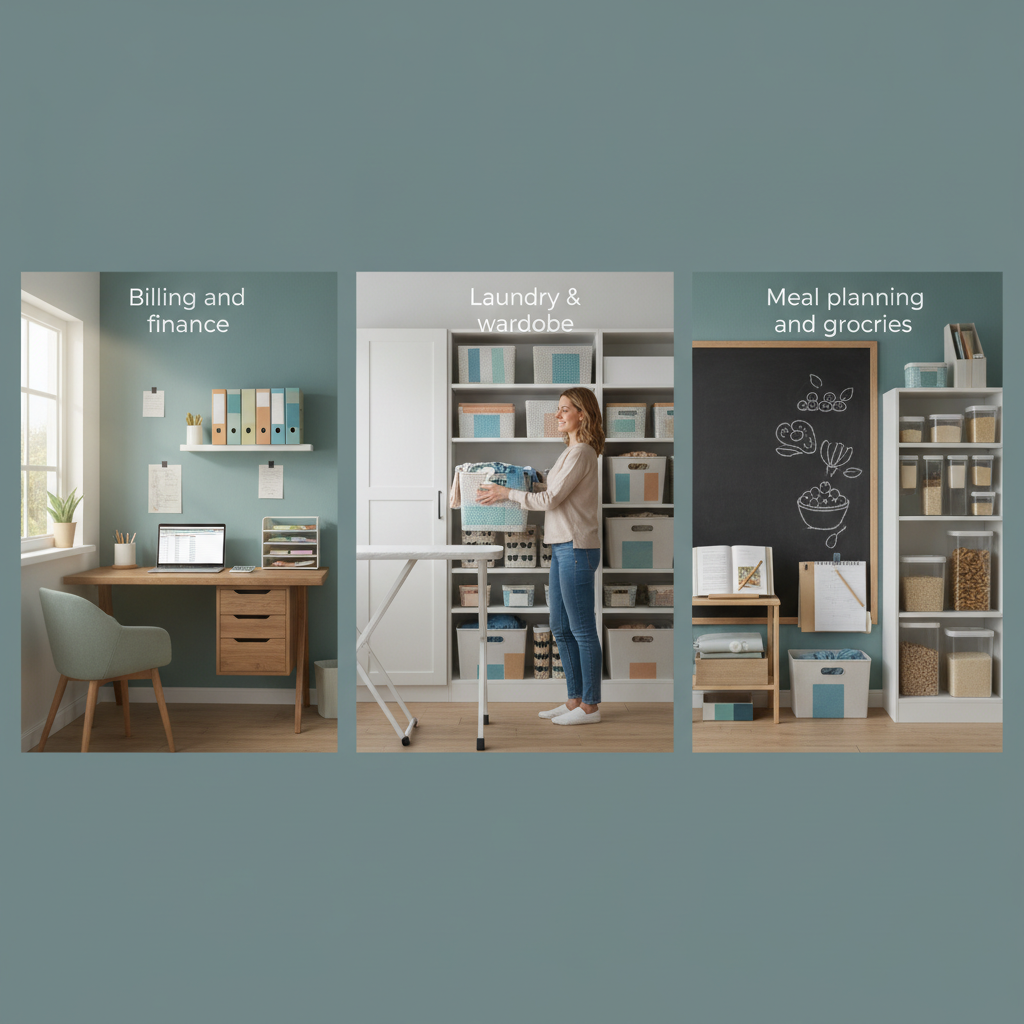
Mental fatigue rarely arrives all at once. It builds slowly across a week through dozens of tiny decisions — where to sit down and pay bills, which corner of the house to sort laundry, which surface becomes the default drop zone for things that need to go somewhere. When tasks don't have fixed homes, your brain quietly spends energy locating them every single time. Assigning specific physical locations to household task categories is one of the most underrated ways to reduce that background drain without overhauling your lifestyle.
How Does Task-Location Pairing Actually Work?
The idea is simple: certain tasks get tied to certain spots, and you don't renegotiate that every week. Paying bills happens at the kitchen desk. Folding laundry happens in the bedroom. Meal planning happens at the dining table on Sunday morning. When a task lives somewhere specific, your brain stops spending energy deciding where to begin. You already know. That automatic quality — what behavioralists call environmental cueing — is what turns a scattered habit into a reliable one over time.
Why Does Wandering Between Spaces Drain Your Focus?
When you carry a task from room to room looking for the right setup, you're not just physically moving. You're also re-evaluating, re-deciding, and often getting distracted by whatever else is in that space. The kitchen counter becomes a bill-paying station and a snack station and a homework surface all at once, and none of those tasks gets your full attention. Splitting task types by location creates low-key mental partitions that help your brain shift modes more cleanly, the way a coffee shop like a neighborhood Starbucks or a local independent café feels distinctly different from your home office, even if the work is identical.
What Tasks Benefit Most From a Dedicated Spot?
Administrative tasks — bills, insurance forms, school paperwork — respond especially well to location anchoring. Set up a single designated spot with everything you need: a folder system, stamps, a charger. Cleaning tasks benefit too. When your supply caddy lives under the bathroom sink, you're not hunting for the spray bottle before you start. The Todoist app and similar tools help people organize task categories digitally, but the physical equivalent of that structure — a real spot in a real room — does something digital tools can't: it turns intention into automatic behavior.
How Do You Choose the Right Location for Each Task Category?
Match the space to the cognitive demand. High-focus tasks like budgeting or scheduling work better in quieter corners of the house, away from foot traffic. Low-focus tasks like sorting mail or folding laundry can go wherever is physically convenient. Think about what you need nearby — outlets, natural light, a flat surface — and let that guide the assignment. The goal isn't perfection. It's consistency. A slightly imperfect spot you actually use beats an ideal setup you avoid because it requires effort to access.
Why Is the Kitchen Counter the Biggest Source of Task Confusion?
The kitchen counter is the most contested surface in most homes. It becomes a staging area for groceries, a homework station, a mail pile, a charging hub, and sometimes an actual food prep space — often all in the same afternoon. That overlap is where mental load compounds fast. When nothing on the counter has a clear category, every glance at it reminds your brain of unfinished decisions. Clearing it down to one defined function — food only, for instance — and relocating everything else to its own spot is one of the highest-leverage changes you can make.
How Does This Interact With Shared Household Responsibilities?
In a shared home, task-location pairing does double duty. When two people know that the bill folder lives in the second kitchen drawer and nowhere else, neither person has to ask the other where things are. The system communicates without conversation. Apps like Notion or a simple shared Google Calendar can help coordinate who handles what, but the physical location layer removes the logistical negotiation that tends to happen in the moment. Less negotiation means fewer low-level friction points, which is where a lot of household tension quietly originates.
What Happens After a Few Weeks of Using This System?
Within a few weeks of consistent practice, reaching for tasks in their assigned spots starts to feel natural rather than deliberate. You stop mentally cataloging where things are. The Sunday bill-paying corner becomes the Sunday bill-paying corner, not a decision you remake each week. Over time, this frees up a surprising amount of cognitive bandwidth — the kind that's been quietly occupied by small, repetitive decisions you barely noticed were costing you anything. That recovered clarity tends to show up not as dramatic productivity, but as a steadier, less cluttered feeling across the whole week.
Start with just one task category and one spot. Pick something you do weekly, assign it a place that makes physical sense, and stick with it for two weeks before adding another. Small and consistent beats elaborate and abandoned every time, and you already have everything you need to begin.